 Repogenic
Reuse, not rewrite
The iPhone app consumes the product’s existing intelligence. One source of truth for ranking and AI behaviour means one place to improve it, and nothing drifts between web and phone.
A working learning-discovery product became a tested, native iPhone app built on its existing intelligence, not a second copy of it.
The request
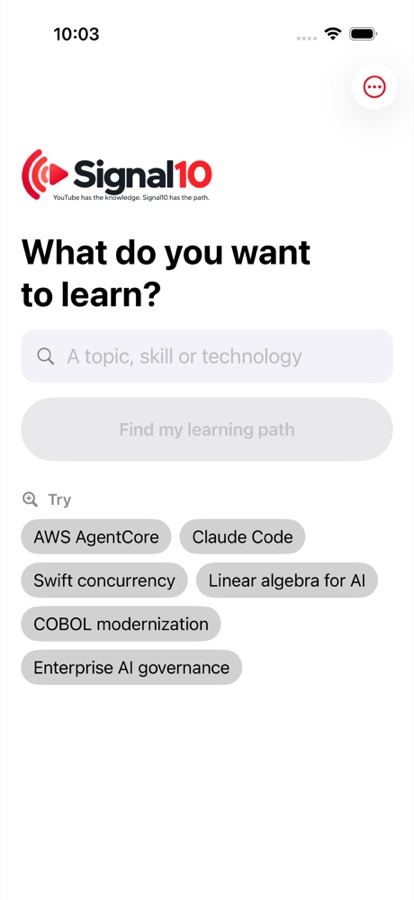
YouTube has the knowledge. Signal10 gives you the path.
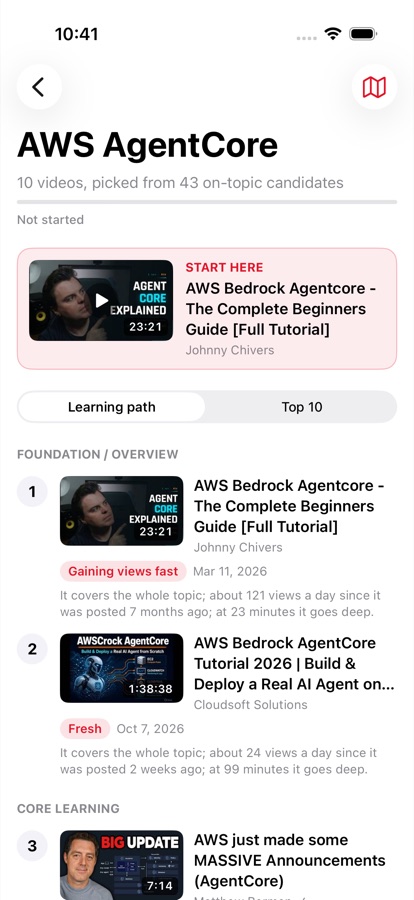
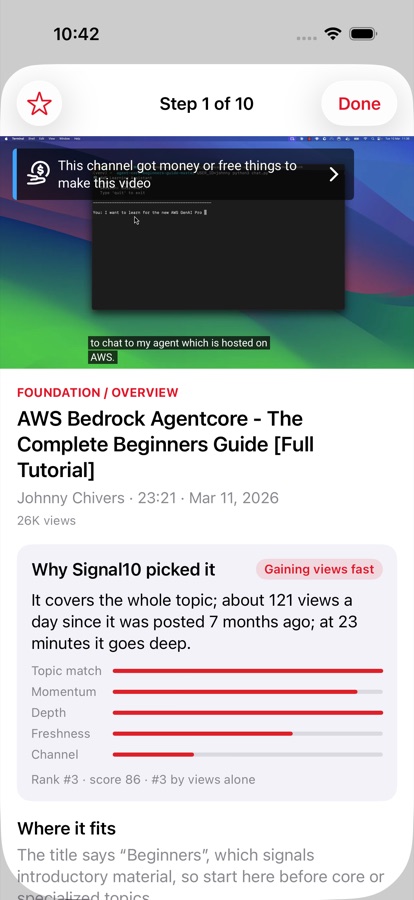
Signal10 answers one question: what are the best videos to watch to learn this subject? It searches YouTube, cuts the noise and duplicates, ranks on more than view counts, and turns the best ten into a learning path. It already worked as a web app.
The brief was to make it a production-quality native iPhone app, with firm boundaries:
How it was delivered
Every step left evidence in the repository, so the speed came with proof.
The brief became a one-page intent with 10 numbered, testable success criteria, written after reading the whole existing repository first.
AI-assisted engineering produced the SwiftUI client, its models and its tests, reusing the existing service’s API instead of rebuilding its logic.
Failing tests were committed first, then code until they passed, then real searches and an automated walkthrough on a simulated iPhone.
Each success merged with its evidence: screenshots, a build-and-run guide, and notes so the next feature starts from what works.
Secret scanning, a no-keys-in-the-app test, untrusted YouTube text rendered as plain text, and the AI boundary kept on the server.
The output
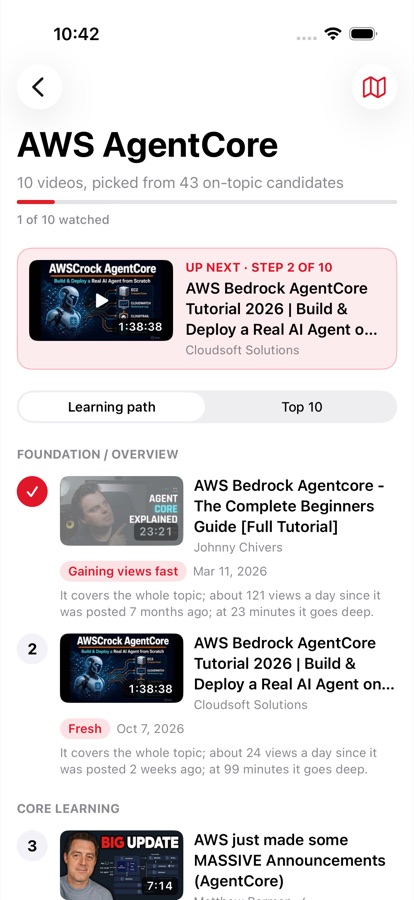
Type a topic, start watching. The app remembers where you are, so coming back always shows what’s next.
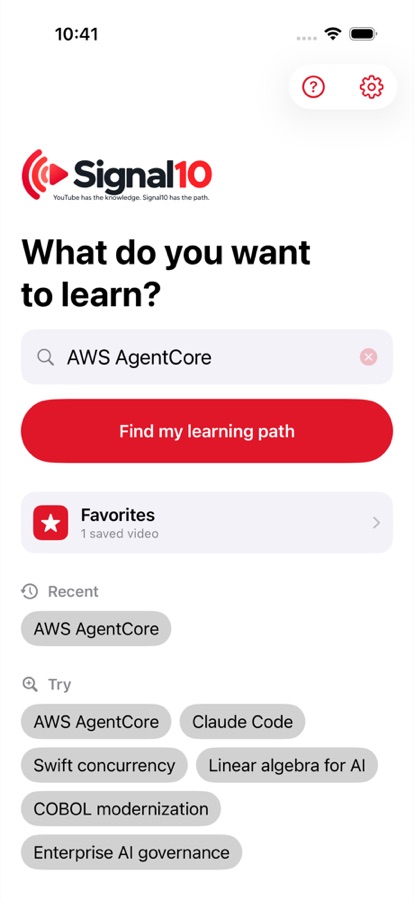
 Signal10
App icon and wordmark carried over from the existing brand.
The evidence
| Tests written before the code | Each feature began with a commit holding only failing tests and the written intent. The git history shows the tests came first. |
|---|---|
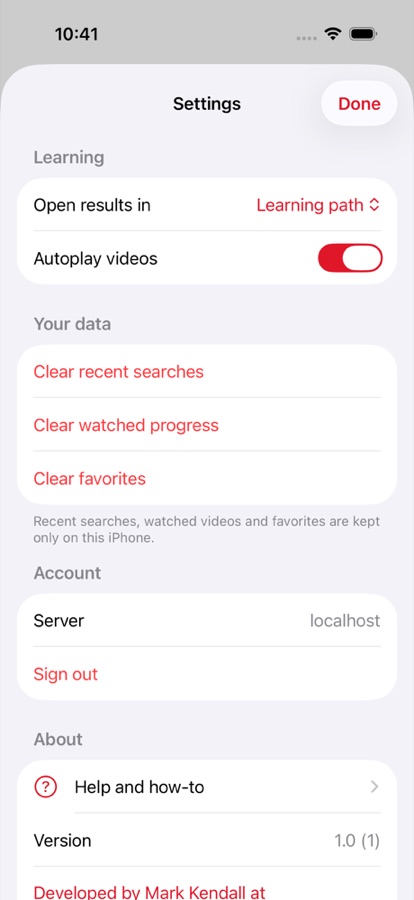
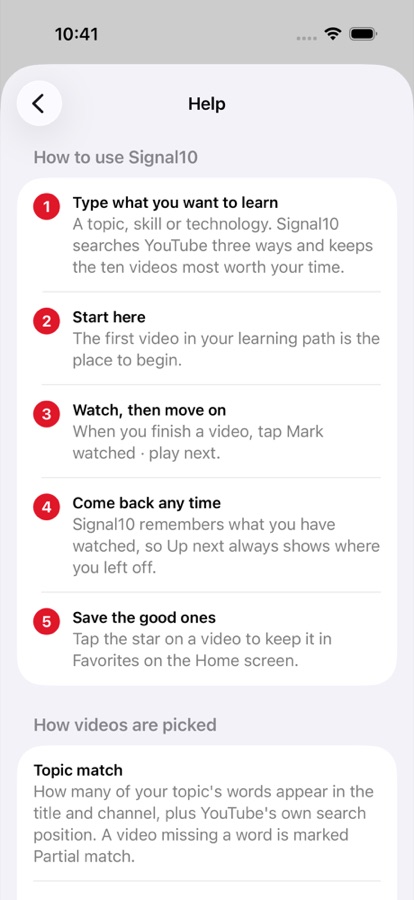
| 30 unit tests, 2 end-to-end tests | Decoding real server replies, sign-in, error handling, progress, favorites, settings and player safety. End-to-end tests sign in, search, play, mark watched, continue the path, save a favorite, and open Settings and Help, with a screenshot at each step. |
| Existing product unchanged | All 79 existing service tests still pass. The web app and its live deployment were left untouched. |
| No secrets in the app | The built app was scanned for keys and credentials, with no matches. A test fails the build if a key ever appears in the app’s settings. |
| Running on real hardware | Signed, installed and used on an iPhone 17. Feedback from the device turned into two quick, tested layout improvements. |
| Second feature, same discipline | Settings, Help and Favorites went through the same loop: an 8-criterion intent, failing tests, code, live end-to-end proof. |
Why it matters
The iPhone app consumes the product’s existing intelligence. One source of truth for ranking and AI behaviour means one place to improve it, and nothing drifts between web and phone.
Secrets stay on the server. The AI provider sits behind the service boundary, so it can move between model vendors, or route by cost, without an app update.
Intent, failing tests, passing tests, screenshots and device builds are all in the repository. That is the RepoGenics difference: faster delivery that holds up to scrutiny.
From intent to a tested app on your own phone, then on to App Store submission in about five days, with the evidence to show for every step.
Talk to Repogenic