 Repogenic
Unknown is not a pass
Missing data becomes a recorded unknown and a NEEDS_REVIEW answer. The agent never fills a gap with a plausible value, which is the failure that makes enterprises distrust agents.
A small AWS reference implementation of a governed enterprise agent. Ask “Can Supplier Acme be onboarded?” and get one of three answers, with every gate citing the evidence records behind it. The model writes the summary. Deterministic code makes the decision.
{
  "evidence_id": "EV-ebb77d5cffb4",
  "capability": "security_assessment",
  "args": {"supplier_id": "acme"},
  "observation": {
    "status": "PENDING",
    "assessor": "SecOps"
  },
  "inference": "Security status PENDING
    does not meet required COMPLETE.",
  "unknowns": []
}
decision: NOT_READY   gates: 2 PASS · 1 FAIL
The request
Agents reason. Capabilities act. Evidence proves.
Onboarding decisions look simple and are not. The answer depends on facts held in different systems, a policy someone else owns, and records that are sometimes missing. An agent that answers confidently from a gap is worse than no agent at all.
The brief was the first template of a reusable decision framework on AWS, with firm boundaries written into the intent before any code:
READY, NOT_READY or NEEDS_REVIEW.How it was delivered
The repository started from intent-drive-starter, so the intent, the gate before code, the rules and the proof were in place before the agent was.
intents/001-supplier-onboarding.md fixed the outcome, the three answers, eight success criteria and the boundaries. A pre-implement hook blocks code until the intent states an outcome and its evidence.
AI-assisted engineering produced the LangGraph workflow, three capability adapters, the policy engine, the evidence store and the FastAPI and Lambda entry points.
21 tests decided what stayed. Each workflow rule has a test named after it, from “capabilities do not decide” to “retry at most once”.
docs/AGENTIC-WORKFLOW-RULES.md traces each rule to the code that enforces it and the test that proves it. Every run leaves an evidence file on disk.
Deterministic gates, a one-retry ceiling, observation kept apart from inference, IAM scoped to one table, one log group and one model, and a manual deploy.
The agentic workflow
A single LangGraph workflow plans three critical questions and answers each with the smallest useful capability call. Calls are keyed by capability and arguments, so an identical call is never repeated. A second pass for more evidence runs at most once, and only when a gap could still change the outcome.
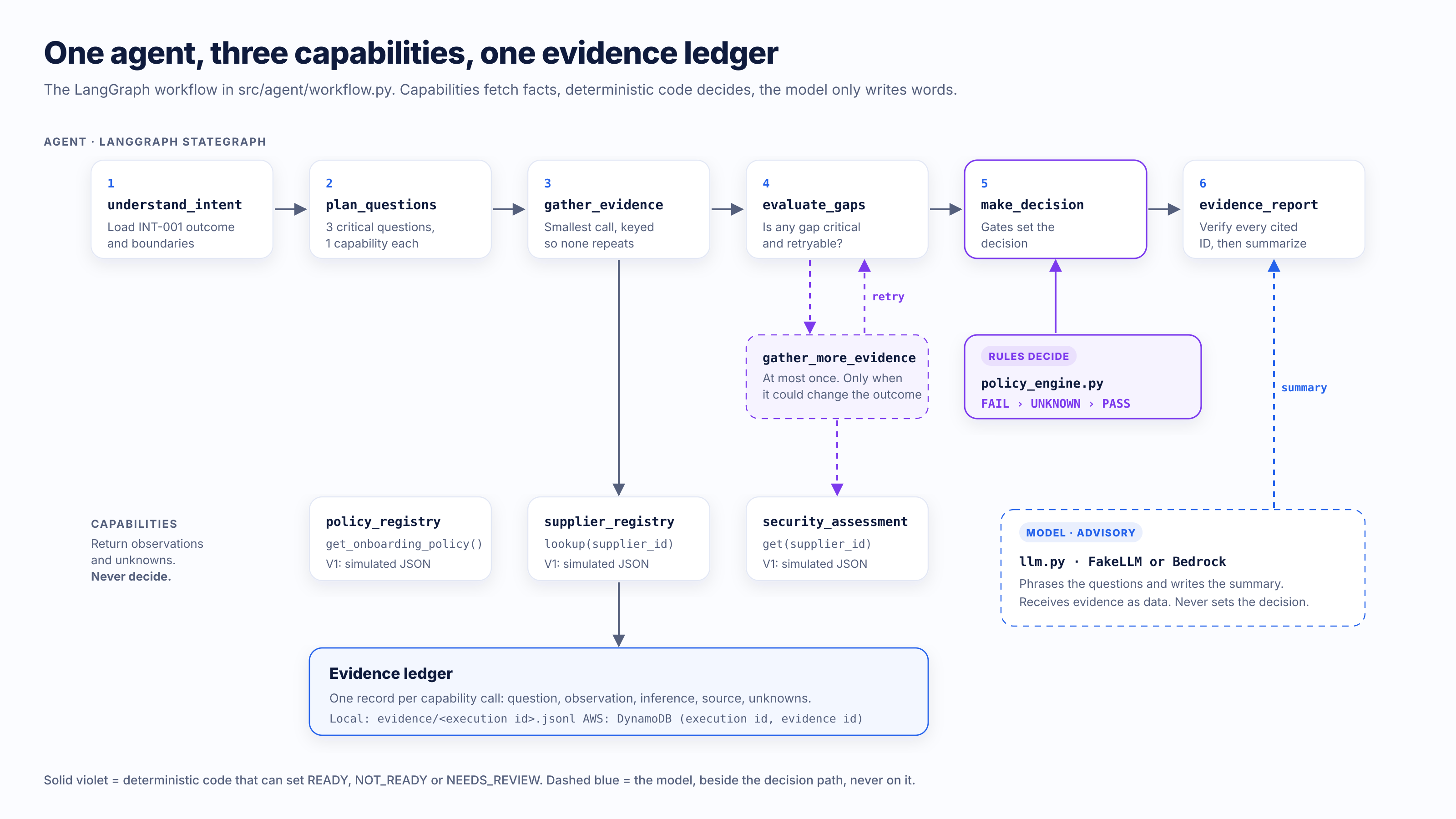
policy_engine.py can set the answer.“Can supplier acme be onboarded?” from request to verdict. Every step below is in the run’s evidence file or report.
NOT_READY. The failing gate cites EV-ebb77d5cffb4.The output
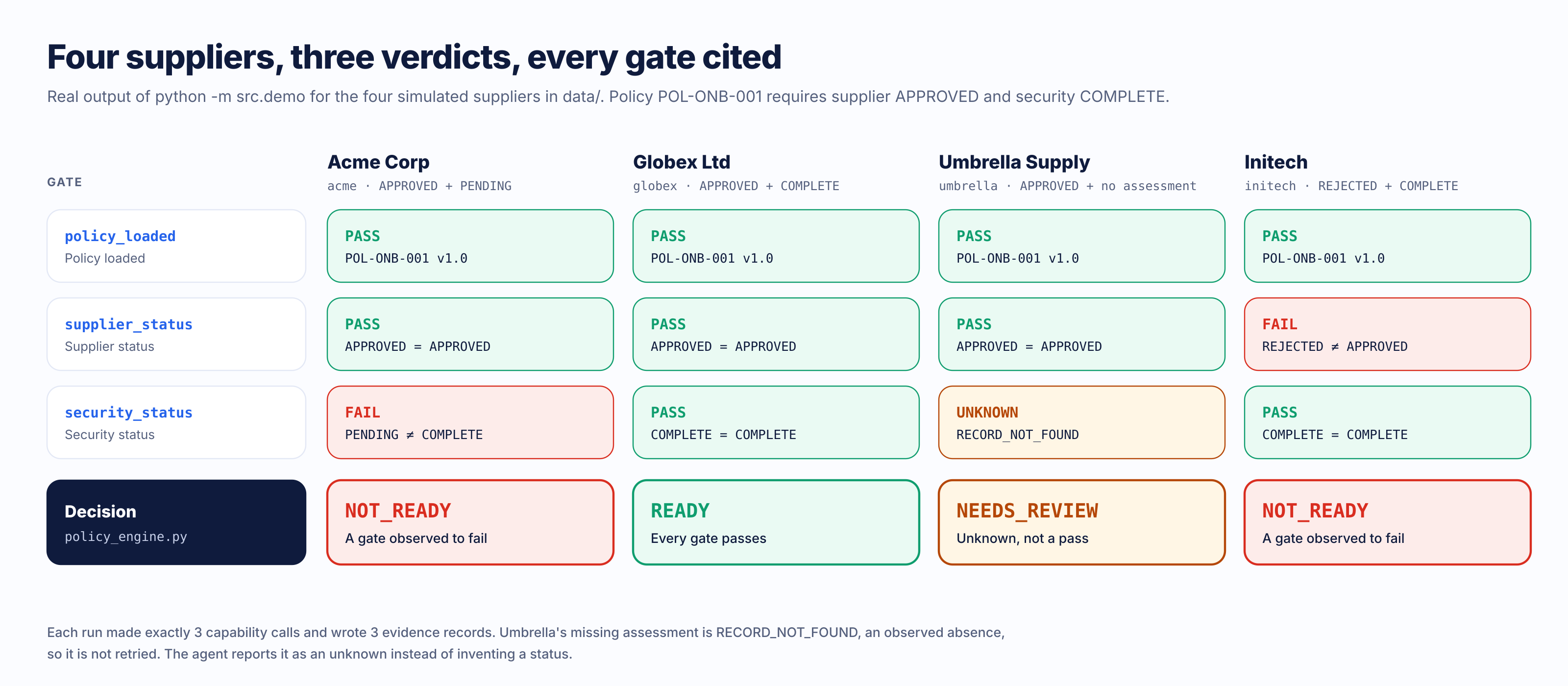
The precedence is fixed in code: a gate observed to fail means NOT_READY, even when other evidence is missing; otherwise any unknown means NEEDS_REVIEW; only when every gate passes is the answer READY. These are the real results for the four simulated suppliers that ship with the repository.
The evidence
| 21 tests passing | VERIFIEDThe full suite runs offline with the fake model and no AWS credentials, locally and in GitHub Actions on every push. CI also runs the pre-implement intent gate. |
|---|---|
| All four demo verdicts | VERIFIEDpython -m src.demo returns NOT_READY for acme and initech, READY for globex and NEEDS_REVIEW for umbrella, each with three calls and three evidence records. |
| Every rule has a test | VERIFIEDEight workflow rules, from “separate observation from inference” to “every conclusion references evidence”, each map to the code that enforces them and a named test. |
| Retry discipline | VERIFIEDTests show a transient failure recovering on one retry, no second retry, no retry when a failing gate has already settled the outcome, and no retry for a record that does not exist. |
| AWS code paths | VERIFIED OFFLINEThe DynamoDB evidence store and the Lambda handler are tested against simulated AWS services (moto). The SAM template scopes IAM to one log group, one table and one Bedrock model. |
| AWS deployment | NOT YETDeployment is manual by design and has not been recorded. The container image has not been built in CI. Nothing is claimed as deployed until it is. |
| Real systems of record | NOT YETSupplier, security and policy data are simulated JSON. There is no policy versioning yet. |
| Summary faithfulness, evidence integrity, review queue | NOT YETThe Bedrock summary is labeled non-authoritative but not evaluated. Evidence is not hashed or signed. NEEDS_REVIEW outcomes have no handoff queue. |
The architecture
The agent loop, gate evaluator, evidence ledger, capability contract and guardrails are built once. A new business question should be a new pack: an intent file, a few capability adapters, a gate list and tests. Supplier onboarding is the only pack built so far; the others are the design target.
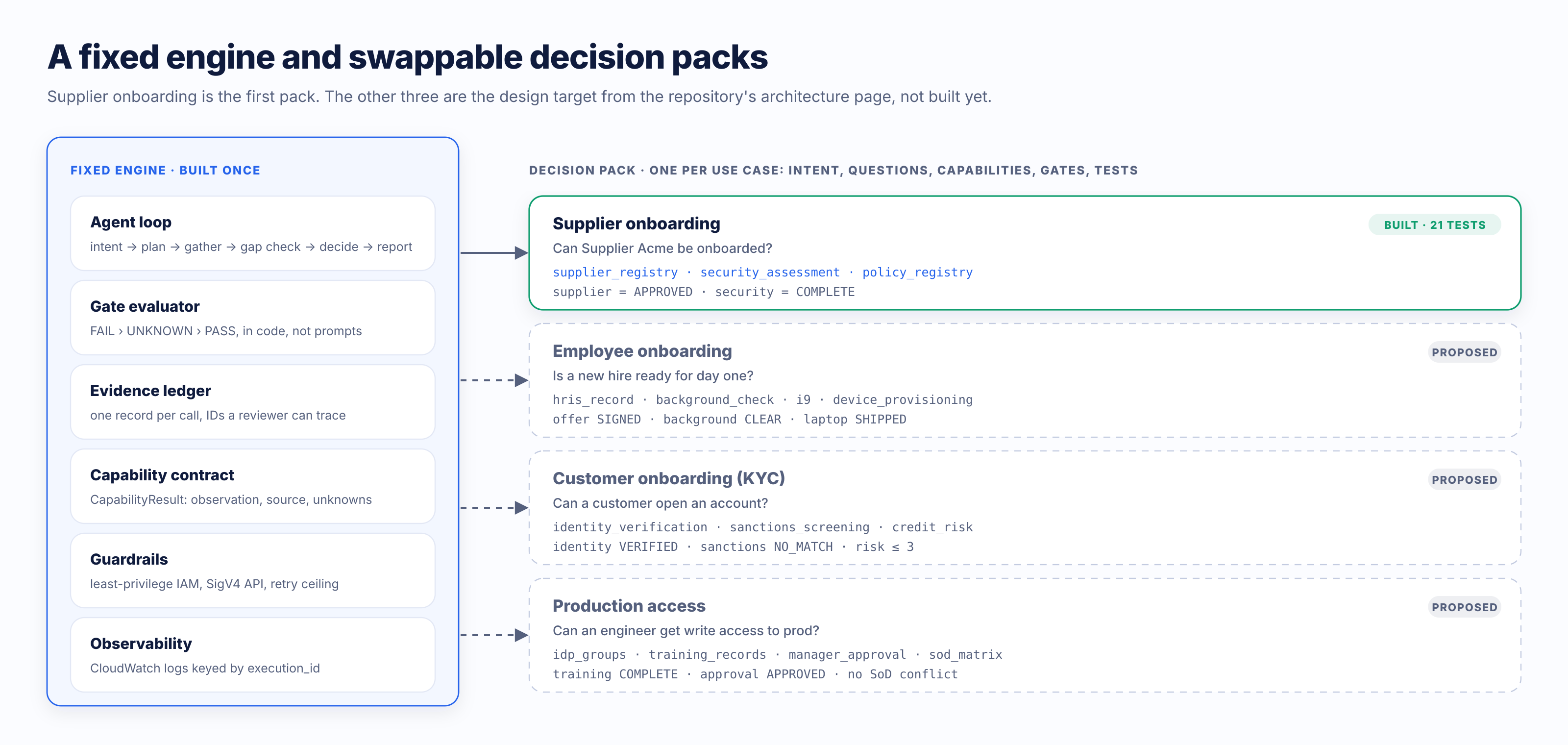
CapabilityResult contract, and the agent, policy engine and tests should not change.Why it matters
Missing data becomes a recorded unknown and a NEEDS_REVIEW answer. The agent never fills a gap with a plausible value, which is the failure that makes enterprises distrust agents.
Every call writes one record with the question, the raw observation, the inference and the source. A reviewer follows the evidence IDs instead of asking the AI to explain itself.
The engine does not know it is about suppliers. Employee onboarding, KYC or production access should bring their own intent, capabilities and gates, not a new platform. That is still to be proven.
From a written intent to a governed decision agent on AWS, with deterministic gates, an evidence record for every call, and unknowns that go to a human instead of being guessed.
Talk to RepogenicReference implementation on simulated data only. It is not connected to real supplier, security or policy systems, and has not been deployed to production.